The Beni: Daily Life (2 of 7)
There is only one way into and out of Betania: a cessna prop plane, your classic ¨puddle jumper¨. My first view of Betania came from the cramped cockpit such a plane, more than a month and a half ago, a simple grass landing strip surrounded by sprawling Pampas (savannah), small islands of palms dotting the endless sea of grass. Toa, myself, and another Parabero named John bounced to a landing and were greeted by a broadly grinning Alonso waiting at the other end of the strip. The next few days, Toa helped me get my bearings, orient myself, and establish the routine that is to be my life for my time in the Beni.
A few days later, I watched him climb into the plane to take him back to Santa Ana, and listened to some last minute instructions and advice. Finally, and right before the prop fired up on the plane, he gave me his dry, slow smile and one last piece of reassurance. ¨Dont´worry man, no pressure. I´m only putting you in charge of the saftey and lives of two of the world´s rarest macaws. One nest could make the difference between life and death of this species. But no pressure...¨ He laughed. I grunted a sarcastic thank you, and his plane charged down the runway and off into the hazy afternoon. I watched for a while, then turned and slowly walked back to the ranch house to begin what has become...
MY DAILY LIFE IN THE BENI
My day begins long before the sun manages to creep above the horizon, at about 5:00 am. This is not my choice, but is rather because of the local wildlife. With uncanny precision, the universe seems to explode simultaneously as the birds that roost in the tree above my tent erupt into the most unnaturally loud and grating chorus I have ever heard. Feel free to share in my pain here:
http://www.xeno-canto.org/browse.php?query=rufous+hornero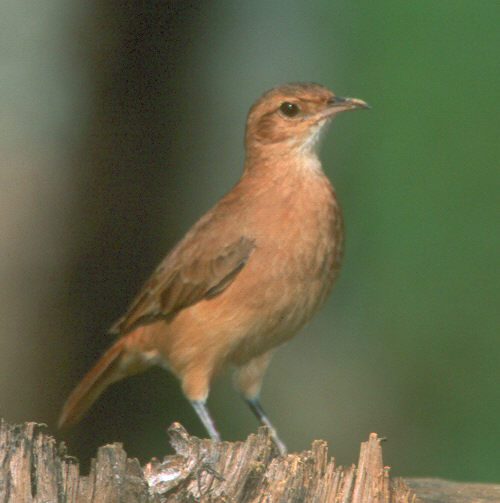 ro
ro
To get the full effect, turn up the volume all the way on your computer, and imagine how it would sound if there were close to 30 of this bird, a Rufous Hornero, singing simultaneously directly above your head. They are actually very cute little birds, that is until they open their mouths (just like a Comm major, ha ha!). It beats a cup of coffee for sheer wake-up power, thats for sure. At the same time, our local rooster enjoys walking by the tent and adding his two cents, just in case I made it through the first wave. Lastly, if I manage to drift off after the Horneros have dispersed and the rooster is causing trouble elsewhere, the pigs come slurping into the yard, and begin rooting around and noisily enjoying whatever they can find in the vicinity of my tent. I have yet to oversleep, to say the least. Once thoroughly awake and irritated, I gather up the supplies that I need for the day, and begin making my way off to wherever I am going while it is still dark, carefully watching my feet to make sure I keep my trail.A few days later, I watched him climb into the plane to take him back to Santa Ana, and listened to some last minute instructions and advice. Finally, and right before the prop fired up on the plane, he gave me his dry, slow smile and one last piece of reassurance. ¨Dont´worry man, no pressure. I´m only putting you in charge of the saftey and lives of two of the world´s rarest macaws. One nest could make the difference between life and death of this species. But no pressure...¨ He laughed. I grunted a sarcastic thank you, and his plane charged down the runway and off into the hazy afternoon. I watched for a while, then turned and slowly walked back to the ranch house to begin what has become...
MY DAILY LIFE IN THE BENI
My day begins long before the sun manages to creep above the horizon, at about 5:00 am. This is not my choice, but is rather because of the local wildlife. With uncanny precision, the universe seems to explode simultaneously as the birds that roost in the tree above my tent erupt into the most unnaturally loud and grating chorus I have ever heard. Feel free to share in my pain here:
http://www.xeno-canto.org/browse.php?query=rufous+hornero
roMy activities of the day follow one of three paths, one taking me in a wide 5 mile loop to our active (meaning that it has chicks) nest, the other in the opposite direction to a potential nest to check the progress there, and the third is not a path at all, but a random search area in a 10 mile radius from the ranch where I check on the other pairs in the area and look for signs of nesting. I go one direction, Paco goes the other, and we often run into each other in between.
If I am going to the active nest, I go it on foot, since I need to be there before it gets light, and I don´t have the time to find, saddle, and coerce El Viejo to get out there in time. Even if I could, my trail passes through a coriche, a broad shallow marsh choked with reeds, water hyacinth and papyrus-type plants higher than my head, and encounters with Caimen are the rule. Caimen are our local crocodilian, small, non-aggressive and basically harmless, and absolutely everywhere in the limited areas that have water. Until recently, my trail has been completely dry, and I have been able to easily skirt the wet areas, but now that the rains have come, my trail is now a small river, and the little twerps have taken to hanging out in it. El Viejo is a stubborn coward, and one look at the little alligators throws him into a fit of snorting, and sends him plodding resolutely in the opposite direction, so he really no help with access to this nest. I have taken to bringing a large stick with me to probe the water in front of me to avoid the surprise of stepping on or kicking one by accident. I´d like to stress that these are very small and not dangerous, I´m not worried about them and you guys shouldn´t be either.
Anyway, my duties at the active nest involve climbing the nest tree (a dead palm snag) to get the chicks out, weighing and taking measurements from the chicks, checking for parasites, and generally making sure that they are well fed, happy, and healthy. After all this has been done, I settle into a blind that we have made nearby, a little shelter where I can see the nest without being seen, and guard the nest from predators, mostly in the form of Toucans and Hawks that try to reach into the nest cavity to get the chicks. If one gets a little too close to the nest, I emerge shrieking and waving my arms to scare them away, and if they still don´t get the hint, I have a slingshot and a pouch full of soft mud balls that I fire in their general direction. The Toucans seem particularly dense, they like to sit and look curiously at me as I fumble with my slingshot, waiting until I actually hit the stupid things to croak in alarm and fly off. Pretty birds, but persistant and stupid enemies of the chicks. This vigil was kept up daily by either me or Paco until the chicks were 3 weeks old, and had reached a size and ability to defend themselves that ensured their saftey from Toucan Sam. Once it starts to get dark and their predators have settled down for the night, I head for home, one hour if I hustle. I´ll talk a lot more about the chicks in my Bird post, I´ve grown pretty fond of them.
I´d also like to take a quick aside to clarify something that has come to my attention. The word ¨chicks¨, which I will be using regularly to refer to BABY BLUE-THROATED MACAWS, does not mean, in the context of this blog ¨women¨. Without this clarification, I´ve gotten a number of messages wondering whether I have been studying birds or collecting a harem in Bolivia. I am not spending my time chasing girls, the word CHICK refers to a baby bird. Looking back though, in a different context, it is pretty hilarious. If you´re bored, I would suggest re-reading the posts with an alternative definition of the word, it really spices things up, but it paints me as some sort of bizzare deviant.

If I´m not checking on the other potential nests to find out whether they are active or not yet, I am out roving around the pampas with El Viejo in search of a particular type of palm tree called Motacu. Blue-throated Macaws are closely tied to this tree for food and nest cavities, so where you find Motacu, you sometimes find Blue-throats and potential nests. I have discovered a couple potentials so far, but only one nest has managed to produce chicks. The other couples seem to still be honeymooning, and haven´t yet gotten serious about settling down to raise kids. It can be a little frustrating at times, I´ve considered bringing some scented candles out to some sites to speed things up, or maybe play some Barry White, I don´t know. Hopefully we´ll see some eggs soon, but not until they quit foolin´ around. In any case, I really enjoy this part of my duties, roaming under an endless blue sky with El Viejo, basically just birding to my heart´s content.
By the time I get home, Maria has something interesting ready to go and in the kitchen waiting for us. I say ¨interesting¨ on purpose, mealtime is so much so, that I will deal with it´s details in the Adventures post. After a nice full dinner and some good conversation with the rest of the crew, I plod my way back to the ranch house and flip on the radio, trying to get a hold of Toa and relay some news, and get any instructions he might have. This usually doesn´t work, our radio is reliable but his is not, so mostly I just sit and listen to the radio happily burble away, spitting out the same sort of noises you would get from R2-D2 if you spiked his oil with tequila. After it becomes clear that nobody is on the other end, I grab my towel and head off to the well to take my shower.
This is something of an adventure in itself. Our water source is an open well with the good ol´ bucket and pulley system, and is a reliable source of extremely clean and often cold water. Great for drinking, less so for bathing. The basic technique is simple enough, I pour myself a five-gallon bucket of water, grab an old gourd that has been cut in half to make a decent cup, and go about pouring freezing water all over myself, soap up, and rinse off. The complications arise as a result of our ever-present wildlife. The well itself houses a huge population of frogs, and your average bucketfull of water contains at least one or two. This means that when it is dark and you aren´t really expecting it, you are fairly likely to pour a bucketfull of amphibians on yourself. I challenge anyone not to laugh at the completely absurb image that this creates; standing next to a well in the Bolivian backcountry wearing nothing but a smile and a handful of tree frogs, determinately clinging to a wide variety of body parts that don´t normally come to mind when you think of frogs. Once I´m satisfactorily clean and have removed the frogs, I head back to the ranch house to read a bit by candlelight before turning in.
The ranch house has been affectionately dubbed ¨The Bat Cave¨, for its population of bats that live in the spaces between the roofing tiles. They keep the mosquitos down near the house, but at a high price. Everything in the house is under constant attack from bat poo, falling bat babies, and being landed on by the bats themselves. They seem to enjoy this, as immediately following a volley of turdlets, a high pitched chittering is always heard, sounding alarmingly like impish laughter. This leads to all sorts of aggressive sentances regarding bats, but in the end there´s not a whole lot to be done about it. I have been woken up more than once from a nap in one of the hammocks in the house by the soft plop of a bat landing on my head.
Once I get tired of brushing off bat excrement, I retreat to my tent, my little fortress of solitude and relative sanitary conditions. I watch the fireflies that hang out between my tent and my rain fly, their lime green flashes come in pulses and are as hypnotic as watching the ocean. The buzzing thrum of cicadas and crickets compete with the chorus of thousands of frogs to dominate the night soundscape, punctuated by the occaisonal owl or nightjar. The last thing I hear before I drift off is often the deep, grunting roar of a Jaguar somewhere miles away, fading off into the night as I end another day in the Beni...
posted by Chris Duke @ 12:04 PM
0 comments


0 Comments:
Post a Comment
<< Home