The Beni: Beastie Report (5 of 7)
Hello again one and all!
Well my field work has officially ended here in Bolivia, and I have emerged from the depths of the Beni for the last time. I am going to be in steady contact with the internet from here on out, and will continue to post on my little adventure down here. More on that to follow with the Beni wrap-up post.
Which brings us to my current post, the complete, the fantastic....
BEASTIE REPORT
NOTE: As I realize that many of you have a lot more on your mind than critters, I am trying to keep the beastie report as lively as possible, with lots of photos. Please pay no attention to the numerous flagrant copyright violations.
Fish
This is a pretty short list, as the water in the Beni is usually the color of a good látte, and thus is not the best for fish-watching (snorkeling here would pretty much be the single stupidest thing you could ever imagine, and I have imagined some pretty stupid stuff in my day). That said, I have managed to positively identify the few that we have caught and a couple others
othersRed-bellied Pirhana- the nasty little fish of lore, they dominate our regular catch. I can personally testify to how sharp their little teeth are, and I have the scar to prove it. By way of experiment, we tied up our chunk of bait at the end of our day one day and watched as the water in the vicinity of the meat began to move, slowly at first, but then came to a raging boil, as dozens of the little beasts threw caution to the wind and demolished our sizable chunk of cow within 15 horrific and seriously fascinating minutes. The whole skeletonize-a-cow-in-three-minutes thing is complete bull, but they are a force to be respected nonetheless.
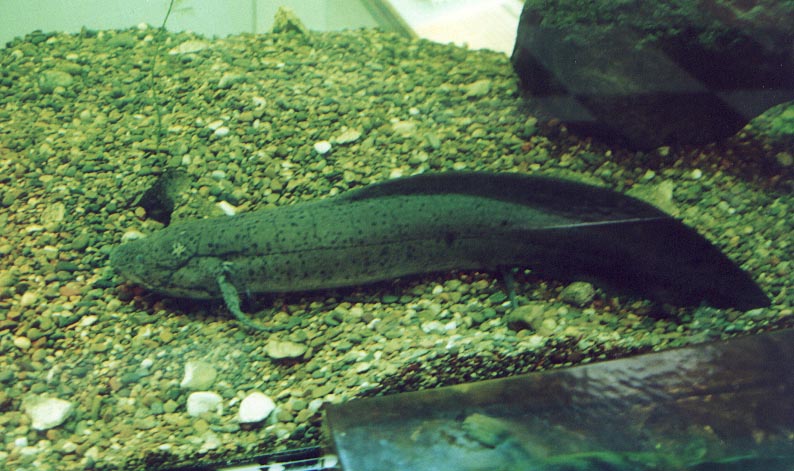 South American Lungfish- this evolutionary curiosity is a hotly-debated ancestor to all tetrapod (four-limbed) animals, an apparrent missing link between fish and amphibians. They are in fact fish, but they breathe air using rudimentary lungs, and in the place of fins, they have wierd, fleshy, limb like tentacles. In my little world, they are present in every decent-sized puddle, you can sit and watch as their little mouths come up to the surface to take a breath, and we even managed to catch one for a closer look. I wouldn´t reccommend handling one if you ever have the chance, they feel incredibly wierd, really slimy and the feel of their little tentacles slapping around is just about the creepiest thing in the world. Super freaking cool though, from a biological standpoint.
Amphibians
Jake, I am hoping that you can give me a bit of a hand here. I really don´t know exactly what species we have running around down here, but as far as I can tell, Leptodactylus sp. are pretty common, as are a wide and never-ending supply of toads. The toads are some of the most common players of Bolivian Whack-a-Mole, and they range from pocket sized to absolutely enormous. We have a pair of especially huge toads (we´re talkin´ POUNDS of toad) that live in the ranch house, and at dusk, the hop out from under the cots where they spend the day, and bonk repeatedly into the door until we let them out. I don´t know how they get back in. I already talked about the tree frogs that live in our well, its always a little wierd to pull up a bucket of water to discover that one or twelve of the little guys waiting to join in the bathing process in their special way. Now that the rains have begun, the frog chorus at night is incredible, with all types of croaks, groans, squeaks, and chirps radiating from every puddle (and a really wierd SPLAT-GRONK!! type noise that the toads like to belt out right next to my tent).
Reptiles
 Spectacled and Black Caimen- far and away the most common reptiles I seemed to run into, the Spectacled are little the little turds that hide in my trail and come boiling out of the water snapping and hissing with all the fury that a 3-foot crocodillian can manage (pictured at left). They are essentially harmless, but
  the first few times I accidentally kicked one while wading through the coriche just about stopped my heart and sent me jumping 20 feet straight up. The Black Caimen are a different story (at right). They only hang out in permanent bodies of water, are big (upwards from 10 feet), and are dangerous. A great reason not to go for a swim in the lakes or rivers. I only saw these big boys occasionally in the lake and along the shore, but one of these times left a strong impression. A baby Capybara was wading around in the shallows one minute, and was torn to pieces by an absolute brute of a caimen the next. They were obviously given a very wide berth and a lot of respect.
Fer-de-Lance- probably the most notoriously venomous, and most greatly feared, snake in the new world tropics. Their name is French for ¨Arrowhead¨ named for their beautiful markings along their back. We found a number of these guys in odd places around camp, where they were either whacked to death with a stick by Alonso, or if I got there before that happened, maneuvered into my (very long-handled) butterfly net and relocated far far away from camp. These guys are only dangerous if you are dumb enough to not respect them for what they are, and are one of my favorite wildlife sightings of the trip, absolutely beautiful.
 ¨Red-tailed¨ Boa Constrictor- another gorgeous snake. We found a big one, about 8 feet or so long, during a night walk. I can´t really say much more, a very pretty snake, I can see why they are such popular pets.
Misc.- others that are less deserving of a full blurb are a wide array of other snakes and lizards that we happened to come accross. Many of the snakes here are excellent rattlesnake mimics, rustling their tails around in the leaf litter to make a nearly perfect reproduction of the Real Deal (I didn´t see any rattlesnakes, Paco had his boot perforated by one while he was tromping through an obviously snakey area. I did warn him beforehand, but his machismo sent him in there anyway. He listened to me more closely after that). The closest I managed to come to an Anaconda was a dead baby that I found in the trail one morning. I guess I´ll have to wait on that one.
Multi-legged Critters
Mosquitoes. Bees. Ticks. Botflies. Ants. Flies. Scorpions. Spiders. All in abundance. Anything else worth mention at this point is a part of my collection, and I´ll show you once I get home. I am a bit disenchanted with this catergory at present, with good reason. ´Nuff said.
Mammals
Some good stuff here, kids... 
Pampas Cat- a very pretty little cat, rare and damn near impossible to find, and one of my prize sightings. I was trudging home one night, and I had stopped to look at a passing bird. As I lowered my binoculars and turned back to my trail, a head popped up in the trail ahead of me, no more than 10 feet away. I froze. In front of me was what I could have mistaken for a huge housecat, if not for its beautiful patterning and wierdly long legs. The eyes. I can´t describe the way that a wild cat´s eyes bore into and through a person, it´s impossible to express, but some sort of a spell just holds you. We stayed like this for at least a minute, until the cat broke eye contact and vanished into the waving grass, leaving no trail, no prints, no trace. An absolute ghost. The cat in the above photo looks seriously pissed off, mine was a lot more composed.
Crab-eating Raccoon and Crab-eating Fox - a couple of funky critters, they make their living largely by feeding on the land crabs that are all over the place (hence the name, duh). They basically are both pretty similar to the ¨basic¨ models of fox and raccoon, but are a lot harder to see and have a strange behavior to them. Cute and fuzzy. 
Pampas Deer and Red Brocket Deer- again, variations on the standard deer theme, Brockets are tiny, with little pointy horns. I actually got a chance to touch a live, very wild baby Brocket. I was walking home from the nest one evening and got trapped in a monster downpour. I settled into a crouch and stayed put as soon as it hit, as I was completely exposed in the middle of an open grassland, and it is a pretty dumb idea to be the tallest object around in a raging thunderstorm. The poor little fawn must have been really disoriented by it, because he came bolting out of a patch of high grass, ran straight to me and buried his head between my boots. We stayed like this until the rain passed, at which point Bambi figured out that I was not, in fact, a really great hiding spot, and went stumbling off after his mother, who had been orbiting me and snorting from a safe distance.
standard deer theme, Brockets are tiny, with little pointy horns. I actually got a chance to touch a live, very wild baby Brocket. I was walking home from the nest one evening and got trapped in a monster downpour. I settled into a crouch and stayed put as soon as it hit, as I was completely exposed in the middle of an open grassland, and it is a pretty dumb idea to be the tallest object around in a raging thunderstorm. The poor little fawn must have been really disoriented by it, because he came bolting out of a patch of high grass, ran straight to me and buried his head between my boots. We stayed like this until the rain passed, at which point Bambi figured out that I was not, in fact, a really great hiding spot, and went stumbling off after his mother, who had been orbiting me and snorting from a safe distance.  The Pampas Deer are another story, they are monstrous, as tall as elk, but they have incredibly long legs, and otherwise look similar to your standard White or Black-tailed Deer. They are pretty jumpy, and they can run in a way I have never seen, they don´t bounce away like White-tails, they gallop with unbelivebly long strides, they look like they are floating. Really impresive.
Giant Anteater- Oh yeah, baby. Another extremely prized sighting, probably the strangest animal I have ever seen. They are known in the Beni as ¨Osobandera¨, literally ¨Flag-bear¨, for the combined effect of their shaggy coats, large size, and their outlandish tail, their ¨flag¨. And th e claws. Jeez. They make a living tearing open rock-hard termite mounds, and their claws are ment for business. They have a truly strange gait, at the front end, they walk on the sides of their enormous claws, turning them inward and sort of pigeon-toeing around. They are nearly blind, and rely almost entirely on their sharp hearing and sense of smell. This means that you can get close enough to them to grab them if you wanted, so long as you are downwind and quiet. Grabbing them would be a bad idea though. Not even Jaguars mess with these guys, they´re slow and bumbly, but they can happily rip you a new one if you screw around with them.
e claws. Jeez. They make a living tearing open rock-hard termite mounds, and their claws are ment for business. They have a truly strange gait, at the front end, they walk on the sides of their enormous claws, turning them inward and sort of pigeon-toeing around. They are nearly blind, and rely almost entirely on their sharp hearing and sense of smell. This means that you can get close enough to them to grab them if you wanted, so long as you are downwind and quiet. Grabbing them would be a bad idea though. Not even Jaguars mess with these guys, they´re slow and bumbly, but they can happily rip you a new one if you screw around with them.Amazonian River Dolphin- Yes, they do exist. They are actually pretty common in the area, they hang out in the main river systems and oxbow lakes. It is really disorienting to see a freshwater dolphin when I am pretty much in the center of the continent, but whatever. Fun, friendly, curious, and playfully goofy. Just what you´d expect from a dolphin. They´re even easier to see in the air, our piolot loves them and always flies super low up the river course so we can see them better.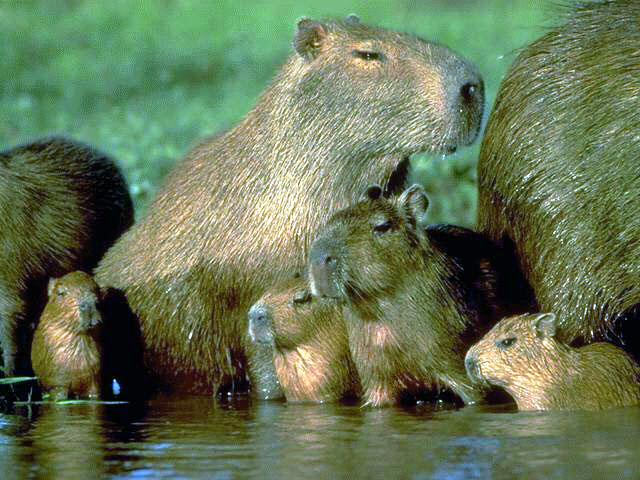
Capybara- the world´s largest rodent, they are about the size of a small pig. Which I think is way too large for a rodent. We always run into the local troop around the coriche at dawn and dusk, and they always greet us with their wheezy, surprized alarm calls, the kind of noise you would get if you punched a congressman of your choice as hard as possible in the stomach. They (the capybaras) always have a really mellow look about them, their eyes always seem half-closed, and they look like they are either super lazy or stoned. Thank God the Vaqueros never made me eat one, they´re really cool, but they just don´t strike me as particularly yummy-looking.
Misc.- In addition to this already huge mammal list, we also saw lots of armadillos, rats, Neotropical River Otters, Howler Monkeys, and a squadron of bats that live in our house. My poor luck with seeing big cats continues, despite the fact that a Jaguar lives in the immediate vicinity of the house, we heard him singing nearly every night, saw his tracks and kills weekly, and we seem to have missed seeing him walk directly past the ranch house by a day, one of the cowboys saw him in broad daylight no more than 30 yards away, exactly one day before I returned from Santa Ana. I really have to break this luck, this is getting riddiculous. Also Heard but not seen was a gorgeous wild dog called a Maned Wolf, would have been great to see, but oh well. I can´t get greedy...
posted by Chris Duke @ 3:26 PM
1 comments


1 Comments:
Hello, nice story!
.
Of course the image of the Red Tail Boa is of a captive produced animal photographed two years ago at my facility in South Texas!
.
Have fun and please ask permission before using more of mu photos.
.
Gus Rentfro/Rio Bravo Reptiles.
Post a Comment
<< Home