Wanderlust: Cochabamba to La Paz
Hello one and all!
Heading down the home stretch now, I have only a while longer in Bolivia. I have much that I have not gotten to do this time, but that is only incentive to return. Anyone reading this can expect two or three more posts, spaced at about a week apart, after which time, my blog will get a well-earned break, and go into inactivity until my next adventure. Please see the photos (which are not mine!! They are Jenny Lee´s!) below as a supplement to details on La Paz...
COCHABAMBA
I left off last as I was getting onto my bus in Santa Cruz, heading off on another 10 hour night journey to the city of Cochabamba. This bus ride was fantastic in comparison to my usual experiences. We even had entertainment, in the form of a young folk band that just happened to be heading our way. After we left the station, they got up into the isle and started jamming, a complete band with traditional Bolivian flutes, pipes, drums, charangos, and a spanish guitar. Probably the best music I have heard in Bolivia to date, these guys were unstoppable, even as people would shove past them in the isle, they simply squeezed into whatever positions they had to to let whoever it was get past them, and just kept playing and singing. A number of the songs that they played are well-known Bolivian folk songs, and the rest of our bus sang along when we knew the words. So our bus bounced out of Santa Cruz, rockin´ down the highway like the Partridge Family, and every once in a while the bus driver would get really into a song and tap the gas rythmically, so the bus would lurch forward in time with the unwavering musicians. One hell of a time, if only they could all be like that bus, that was a PARTY.
But they did eventually quiet down, and we did eventually get into Cochabamba, the town with what is widely regarded as the nicest climate in the country, with dry, warm, sunny days, and cool nights. The city lies in a wide yawning valley, at a middle elevation of about 2000 meters (around 6000 feet). It is surrounded by towering mountains, including Cerro Tunari, one of the country´s tallest, I am told, and the valley contains a broad marshy lake called Laguna Alalay, and some of the best birding of my trip. This is high desert area, averall shockingly similar habitat to Albuquerque, the sole difference being the proximity to the equator, which limits the variation between seasons. Some of the myriad sayings I heard by locals include (translated) ¨The swallows never migrate from Cochabamba¨, ¨The purest skys in America¨, and ¨Cochabamba´s eternal spring¨. It does indeed seem to be locked in a never-ending Southwestern April, a very nice change from the sweltering tropics.
Watching over the city with outstretched arms is El Cristo de la Concordia, an emmense statue of Jesus perched atop a hill at the edge of town. The statue is just over thirty-three meters tall (100 feet or so), or a meter for every year of Christ´s life. In fact, it is just a hair taller than the famous Cristo Redentor in Rio de Janeiro, Brazil, a fact that the locals cherish (even the Lonely Planet guide noted this). They claim that this is because Christ actually lived just a little longer than thirty-three years, so they are justified in one-upping Brazil. This was my first stop in Cochabamba, definitely impressive. You can take a taxi to the top via a long desert road, hike up a huge stairway from the base of the hill, or take the new cable car to the top. Even here the altitude hits hard, I chose to taxi up to the top and hike back down. Great views from the town at the top, lots of pilgrims from around the country were here as well, the first time I have seen tourists from within the country.
My next two days in Cochabamba were affected by a cold that I picked up, undoubtedly from one of the busses, so I spent my days quietly walking and birding around the lake and into the hills around town, focusing on acclimatizing to the altitude and trying to shake the cold, the remenants of which are still lingering today. My body gets very sulky when I subject him to sudden altitude changes, and getting a cold on top of that turned him absolutely pouty. I drank a lot of organge juice to try to convince him to snap out of it. I did have to be hitting the road though, so once I was back to about 70 percent, I hopped on the bus again, and after a brief stop in Oruro (the New Jersey of Bolivia. As soon as I got into town, one look was all I needed to catch the next available bus out. A really uncharming town to me, even by Bolivian standards), I was heading of to the capital, the sky-high city of...
LA PAZ
My return to the city where it all started, I have time to actually get to know the city, rather than my previous experience, simply passing through the airport. La 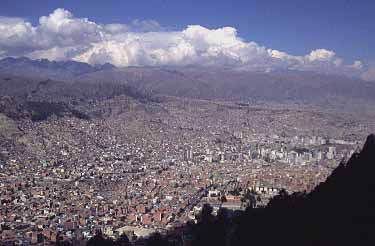 Paz is the land of altitudinal superlatives, and has nearly the highest everything; the highest capital, the highest international airport, and is surrounded by some of the highest mountains in the world. This is the Bolivia that most people see, and tourism is a much more visible presence here, much to my chagrin. While this is the first town I have been in where some level of English is spoken, it is usually just enough to pester me while I am shopping. The most common phrase I have heard in English is ¨You buy, is very pretty Meester.¨ Spanish is even a second language to many people here, Aymará and Quechua are the main languages spoken by many of the people here, especially the Cholas (traditionally dressed women that live in the cities). These two languages date back to Pre-Spanish and even Pre-Incan times, a strong reminder of the rich past that remains such a visible part of the culture´s present.
Paz is the land of altitudinal superlatives, and has nearly the highest everything; the highest capital, the highest international airport, and is surrounded by some of the highest mountains in the world. This is the Bolivia that most people see, and tourism is a much more visible presence here, much to my chagrin. While this is the first town I have been in where some level of English is spoken, it is usually just enough to pester me while I am shopping. The most common phrase I have heard in English is ¨You buy, is very pretty Meester.¨ Spanish is even a second language to many people here, Aymará and Quechua are the main languages spoken by many of the people here, especially the Cholas (traditionally dressed women that live in the cities). These two languages date back to Pre-Spanish and even Pre-Incan times, a strong reminder of the rich past that remains such a visible part of the culture´s present.I met up with Jenny Lee here, a wonderful girl and great friend from way back, and we spent a couple days wandering around the city and trying to recover from the spinning dizzyness and pounding headache that herald the arrival of Soroche, the Altitude Sickness. The highest point in the La Paz area is at the lip of the canyon in which the city hunkers down into, a sprawling ghetto known as El Alto (The High Place), at just a bit above 4000 meters. To give you a sense of perspective, the summit of Mount Ranier is at 4392 meters, so to carry on regular life at this altitude is a challenge. The Paceñas (La Paz-ites) will tell you to walk slowly, eat small amounts, and ¨duerme solito¨, to keep from feeling El Soroche, which seems biologically sound, since strenuous excercise and big meals draw blood (and therefore oxygen) away from your brain and towards other, technically less important body parts.
As for the general character of La Paz, I think the photos in the two previous posts speak for the town far better than I could. Hopefully you can get a sense of the bizzare contrasts and contradictions that make La Paz, and indeed Bolivia in general, the most fascinating and quirky place I have ever seen. By way of example, in a single day in the same city, I saw a political gathering and protest, a speech by the president, Evo Morales, an inpromptu folk music performance mid-march, countless dried Llama fetuses for sale in the Witches´ Market, the most beautiful painting I have ever seen, a number of signs prohibiting public urination, a Jazzercise work-out in a modern gym, skyscrapers, mud huts, Cholas with cell phones, advertisements for charango lessons and internet classes, and a person in a Zebra costume directing traffic for a parade with a homemade sign that read: Cross San Pedro Blvd two blocks down, don´t be a ¨Donkey¨. Sigh. Boliva.
BEASTIE REPORT
Not a whole lot to report here besides birds, the cool nights at these high elevations pretty much  cut most bugs, reptiles, and amphibians out of the picture. So that said...
cut most bugs, reptiles, and amphibians out of the picture. So that said...MAMMALS: Now that I am in the Altiplano, Bolivia´s most celebrated fauna have become obvious: Llamas and Alpacas. Goofy looking buggers, but they serve the local Campesinos well for pretty much all they need, pack animals, wool, meat, and even milk. Not exactly wild animals, Llamas and Alpacas are descended from wild Guanacos and Vicuñas, respectively. But they are extremely Bolivian, there are very few tourism posters here without an obligatory Alpaca in the corner. Other tha n that, the only other mammal I saw was a huge rat running accross the road in Cochabamba that my cab driver tried to hit.
n that, the only other mammal I saw was a huge rat running accross the road in Cochabamba that my cab driver tried to hit. BIRDS: Some of my best birding of the trip, lots of new species. Lots of desert finches and sparrows, waterbirds, and the Aplomado Falcon, a member of a family that is very near and dear to my heart (photo right). Also the very flashy Blue and Yellow Tanager (left).
posted by Chris Duke @ 5:23 AM
0 comments


